Get to Know Krista Walton, NC State’s New Vice Chancellor for Research and Innovation
The sixth-ever vice chancellor to lead the Office of Research and Innovation shares how her upbringing on a rural farm helped shape who she is today; what she wanted to be when she grew up; and her favorite part of campus so far.
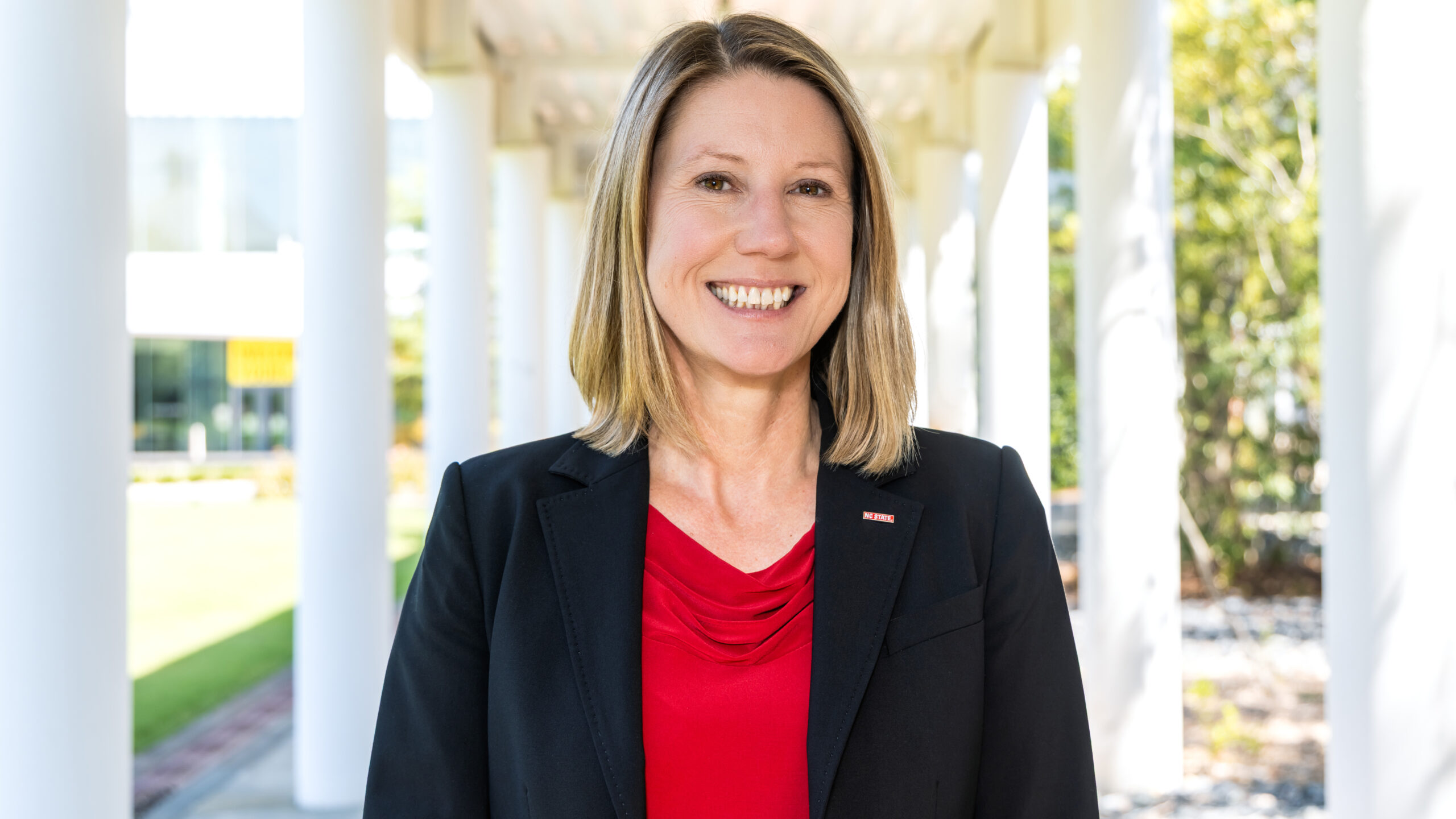
In July, Krista Walton took the helm of the Office of Research and Innovation as the sixth vice chancellor in our history.
Walton, an Alabama native, came to NC State from the Georgia Institute of Technology, where she served as associate vice president for research operations and infrastructure.
While she’s only been on campus for the better part of two months, you could argue that Walton has been gradually preparing since her childhood to oversee the research enterprise of a land-grant university like NC State. Her father’s a lifelong farmer who grows wheat, soybeans and a range of other row crops.
“I think growing up that way gives me a natural connection to and appreciation for the land-grant mission,” Walton says.
Walton grew up working on the family farm. So she got involved in her local 4-H youth development program at an early age. And in middle school, Walton was a regular participant in Science Olympiad competitions, which would take her to Alabama A&M University, the nearest local land-grant institution.
“That was some of my earliest involvement with STEM,” Walton says.
When it came time to pick a major after becoming a college student herself, Walton says she knew that, no matter what, she wanted to do something in STEM that made a positive impact.
“I was considering what I wanted to study, and I knew that I ultimately wanted to do something for work where I could use science and technology to directly improve people’s lives and communities,” Walton recalls.
While she may not have known what land-grant institutions even really were at the time, their core mission — research and extension that benefit everyday people — was nonetheless top of mind.

Reaching for the Stars
Walton’s journey to NC State ended up far different than her younger self expected. Science has fascinated her for almost as long as she can remember, but the job of vice chancellor for research and innovation wasn’t even remotely on her radar.
Rather, like a lot of kids, Walton aspired to become an astronaut.
“My real dream as a kid was to be an astronaut, so I could do science in space,” Walton says. “And, actually, I would still go to space right now if anyone reading this needs somebody.”
In middle school, attending space camp at NASA’s U.S. Space & Rocket Center bolstered her dreams even further.
When Walton left home for college, she thought she was getting herself much closer to those dreams — both figuratively and literally. Walton went to the University of Alabama in Huntsville (UAH). NASA’s Marshall Space Flight Center also happens to be housed in Huntsville.
“I thought, at a minimum, I’m going to work at NASA, right?”
Walton spent her senior year of undergrad interning at Marshall Space Flight Center, studying protein crystal growth in microgravity. And she had every intention of pursuing astronaut candidacy until she was finishing her doctorate work, which was funded by NASA’s Ames Research Center.
NASA’s astronaut program is highly competitive — only 360 candidates have been selected since the agency’s 1959 inception — but that didn’t faze Walton one bit. She was prepared for the reality that she might not be selected, and that even if she were, many astronauts never get the opportunity to go to space. But there was no doubt in her mind she’d end up at the agency one way or another.
“I thought, at a minimum, I’m going to work at NASA, right?” Walton says.
Then the Columbia space shuttle disaster happened. NASA would put all flight missions on hold for the next two years. Among other factors, this tragedy and subsequent pause on the space shuttle program suddenly forced Walton to reconsider her next steps.
At this point, Walton was well on her way to completing her doctorate degree in chemical engineering at Vanderbilt University.
“And pursuing a Ph.D. was some of the most fun years of my life — I’m not kidding,” Walton says.
She first learned how much she loves being in the lab when she did undergraduate research at the Marshall Space Flight Center.
“That’s when I really started to think, ‘OK, this is what I love doing,’” Walton recalls.
But for a long time, she still couldn’t see herself staying in academia. Instead, she figured she’d end up in an industry gig or, if not with NASA, another government agency. As she got closer to graduation, though, she was faced with the prospect of putting an end to research of her own, which focuses on functional porous materials for use in adsorption applications, such as atmospheric water harvesting and air purification.
“I had a lot of offers, in both industry and government labs. But the thought of leaving behind the research I’d been obsessed with for almost five years made me realize that I probably needed to pursue a faculty position,” Walton says. “I just couldn’t wait to start my own lab to pursue new ideas, collaborate with others, create new knowledge, and train future scientists and engineers.
“That was almost 20 years ago. So I guess it worked out,” Walton says.

Running a Research Enterprise
Even though she might not have ended up as an astronaut, Walton’s goals today remain as ambitious as ever.
She’s well aware of the challenges presented by recently proposed cuts to research funding at the federal level. But Walton believes that merely means now more than ever, we must help show why research matters — and elevate NC State’s visibility and profile at the state, national and global levels.
“Our researchers are doing awesome things, and I want to do everything I can to make sure their stories reach the widest audience possible,” Walton says.
First and foremost, however, Walton knows she must listen and learn.
“I want to meet with as many faculty, staff, students and partners across campus as I can to better understand all of NC State’s various strengths and position us for new growth,” Walton says. “I really want to do a deep mapping of our research ecosystem.”
An equally important part of meeting with as many campus stakeholders as possible is building trust and relationships.
“I’m new here,” Walton says. “So I want to focus on getting to know the people who make research happen at NC State and ensure that ORI is a genuine partner in the research journey of our faculty and staff — supporting, enabling, and celebrating their discoveries and innovations.”
Vice Chancellor Walton will hold a series of town hall meetings this fall semester. Details are forthcoming; if you’re interested in attending a town hall meeting, please contact [email protected].
- Categories:


