20 Years to Grow on: Future-proofing NC State’s Covington Sweetpotato
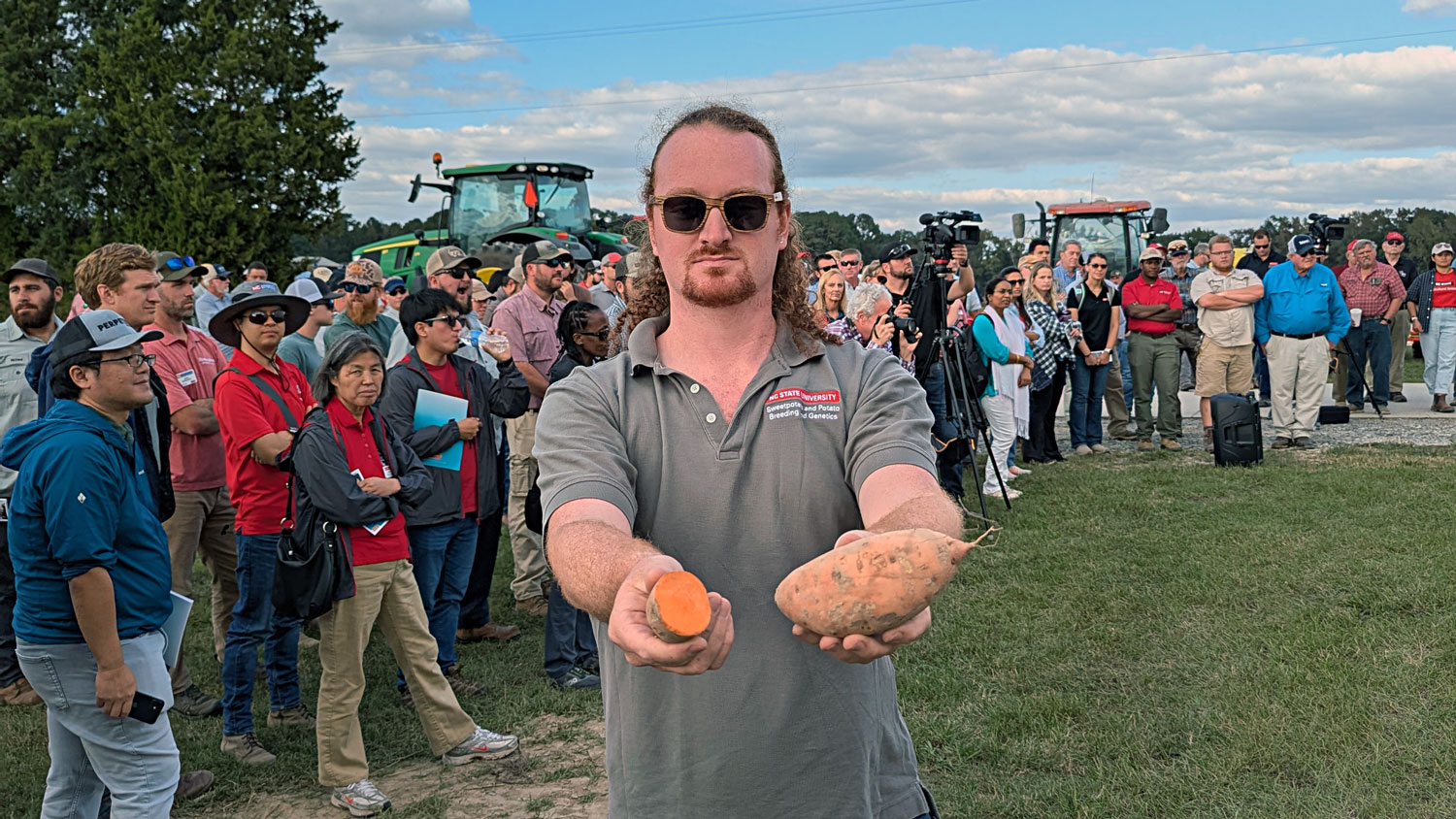
Twenty years ago, with little fanfare, researchers at NC State University released a new sweetpotato variety named Covington.
At the time, plant breeders didn’t know that Covington would become North Carolina’s dominant sweetpotato variety within five years and generate billions of dollars in farm gate revenue over the next 20 years.
“Five billion,” says Craig Yencho, leader of the Sweetpotato and Potato Breeding and Genetics Program at NC State and a William Neal Reynolds Distinguished Professor in the Department of Horticultural Science. “I had no idea.”
Covington ranks among the most important plant varieties that NC State University has ever released. About 90% of sweetpotatoes planted in North Carolina and 60% of those planted in the U.S. are the Covington variety. With consistent yields, high quality and a longer storage life, Covington laid the foundation for North Carolina’s successful export industry, which ships sweetpotatoes to 34 countries, with Europe as the top market.
In fact, Covington’s impressive track record makes it tough to top, Yencho says. Growers who attended the 2025 North Carolina Sweetpotato Field Day, held in October at the Horticultural Crops Research Station in Clinton, want the next variety to be “just like Covington” but with improved pest and disease resistance.
Race To Add Resistance
The guava root-knot nematode, a microscopic roundworm that attacks both fibrous and storage roots in sweetpotatoes, poses the biggest threat to Covington. The destructive pest slashes sweetpotato yields, and it can survive in over 200 other crops, weeds and native species that grow in North Carolina. NC State scientists have helped farmers cope with the pest using a combination of changes in growing practices and nematicides, but it’s not a long-term strategy.
“We hear from growers that they need guava root-knot nematode resistance yesterday,” says Simon Fraher, a postdoctoral researcher with NC State. Fraher has identified molecular markers for resistance to both guava and southern root-knot nematodes. Fortunately, resistance seems to be a trait that’s highly heritable, which means that breeding with resistant parents should produce resistant offspring — potential new varieties for North Carolina growers.


Fraher’s markers have a 96% success rate in identifying lines with resistance to the guava root-knot nematode, and an 80% success rate with resistance to the southern root-knot nematode. Genetic screening tests can be performed on a sweetpotato leaf or tissue sample.
Unfortunately, none of the commonly cultivated varieties in the U.S. possess resistance to the guava root-knot nematode. The best resistance — identified after screening known varieties from South America, Asia, Africa and U.S. breeding programs — comes from a landrace or locally adapted variety called Tanzania that’s suited to conditions in Africa but doesn’t grow well in North Carolina.
Crossbreeding Covington with Tanzania involves a lengthy process and brings unwanted baggage: differences in sweetpotato texture, color, growth habits and other traits.
“The material that has guava root-knot nematode resistance also is missing some of the key characteristics that we need in a new variety, in terms of what we need for our industry, our growers and our consumers,” says Kenneth Pecota, senior research scholar with NC State’s Sweetpotato and Potato Breeding and Genetics program.
The painstaking process of plant breeding also requires thorough field testing to determine if resistant varieties hold up under growing conditions on the farm, Pecota adds.
No one wants to lose the many desirable traits that Covington possesses, including tolerance to heat, floods and droughts; consistent shape and size; nutritional makeup; storage life; and culinary quality.
“Breeders are looking at 35 to 40 traits,” Yencho says. “Not wanting to lose any of those makes it hard to get to the next major variety.”
Fortunately, a new approach could help speed up the breeding process.
Genome Editing: Precision and Speed
Using genome editing, an improved Covington with guava root-knot nematode resistance could be ready in five or six years instead of 10 to 15, Yencho says. It’s a faster, more precise process.
In July, Tim Kelliher joined NC State as head of the new Genome Editing Center for Sustainable Agriculture, after 12 years with Syngenta, where he led research programs related to breeding technologies and genome editing trait development in major row crops. Yencho had a research challenge for Kelliher in mind.
Yencho and Fraher have identified a genome region responsible for controlling resistance to the guava root-knot nematode, and they’re exploring potential candidate genes that cause that resistance. Once a specific gene is identified — one of thousands in a sweetpotato’s DNA — NC State researchers like Kelliher can edit that gene into susceptible cultivated varieties, especially Covington.
Traditional breeding would take years to incorporate resistance to this nematode, and those 35-40 traits all must meet or exceed Covington’s to become a commercially viable success.
“That means we can’t provide farmers with a version of Covington that has this resistance gene through traditional breeding in a short period of time,” says Kelliher, the Roberts and Mikhail Distinguished Chair in Plant Genome Editing. “It would probably take another 10 to 15 years of breeding and additional resources to fix those quality, yield and agronomic traits and get the resistance we need.
“And so the Genome Editing Center is offering a shortcut to that.”
Through genome editing, researchers would edit the resistance gene directly into the Covington line, without introducing other unwanted characteristics.
The resulting new Covington variety wouldn’t be a GMO, or genetically modified organism, Kelliher emphasizes. “Importantly, with this technology, we are only using DNA from sweetpotatoes, so there’s no DNA from any other organisms.”
Using either genome editing or a process called cisgenesis emulates what could be accomplished through traditional breeding techniques; however, it cuts out years of crossing and backcrossing, and it allows breeders to conserve all the other desirable qualities of beloved varieties like Covington.

The next steps will be up to the many stakeholders involved, who have worked together on challenges facing the industry, including growers, NC State scientists, the NC Sweetpotato Commission, the N.C. Department of Agriculture and Consumer Services, and the N.C. Plant Sciences Initiative. Research funding has also come from a number of state, federal and private sources, including the U.S. Department of Agriculture, the International Potato Center and the Gates Foundation.
“We have some innovative technologies to use,” Yencho says. “We have better tools now.“ NC State researchers are working tirelessly to use these tools and technologies to deliver a new guava root-knot nematode resistant variety to growers faster than previously thought possible.
North Carolina: The Sweetpotato State
- Top sweetpotato-producing state in the nation since 1971
- Grows more sweetpotatoes than all other U.S. states combined
- Enshrined the sweetpotato as the state vegetable
- First U.S. state to export sweetpotatoes to Europe in 2007
This post was originally published in College of Agriculture and Life Sciences News.


