Leading GES into the Future: A Conversation with Khara Grieger

For Khara Grieger, leadership is about teamwork, collaboration, and a shared vision. Now, as she steps into the role of Deputy Director and prepares to lead the Genetic Engineering and Society (GES) Center in 2026, she is focused on guiding the Center into its next phase—strengthening partnerships, broadening impact, and embracing the challenges of a rapidly changing world.
Carrying the Legacy Forward

This transition comes as co-founders Jennifer Kuzma and Fred Gould step back from formal leadership roles after more than a decade of shaping the GES Center into a nationally recognized hub at the intersection of biotechnology, policy, and public engagement. Earlier this year, Fred retired after nearly 50 years at NC State, capping a career that helped shape global conversations around genetics, ecology, and governance. Jennifer, who will continue to be deeply engaged with GES as a faculty leader and collaborator, remains an active force in the Center’s research, mentoring, and responsible innovation work—ensuring continuity as the Center evolves.
“GES will be in good hands with Khara at the helm.” — Fred Gould
From the perspective of those who built the Center, Khara’s leadership feels both fitting and inspiring. Fred describes her as “competent, creative, empathetic, and appropriately humble,” qualities that, he adds, make people “really enjoy participating in her teams.” Jennifer Kuzma echoed that confidence, describing Khara’s blend of management skill, interdisciplinary expertise, and international presence as “exactly what GES needs for the future.”
Rooted in Interdisciplinarity
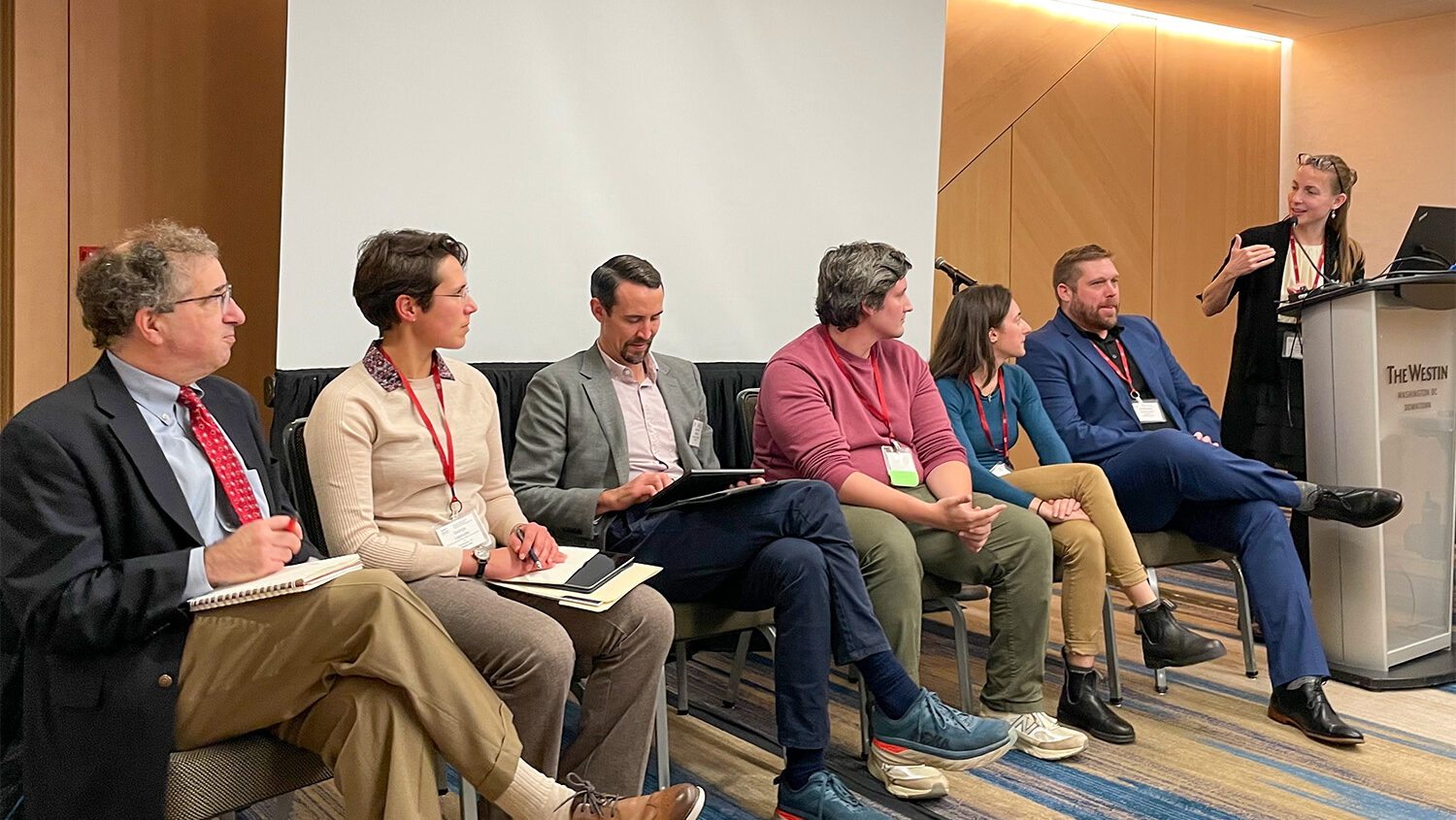
Khara joined NC State and GES in 2019 after 7 years as a Senior Environmental Research Scientist at RTI International. She describes the move as finding her professional “home”—a place where researchers from the natural and social sciences, engineering, and the humanities work side by side to understand the risks and societal implications of emerging technologies under conditions of deep uncertainty. In 2020, she joined the Department of Applied Ecology as a faculty member and continued her involvement in the GES Center as an Executive Committee member.
As she looks ahead, Khara envisions GES becoming an even stronger hub—nationally and internationally—for interdisciplinary research on the roles of emerging technologies in society. She talks about leading not just with ambition, but through inclusion, listening, and collaboration.
“I see my role as thinking big about where we want to go and doing so in an inclusive way.” — Khara Grieger
Leadership as a Team Sport

Her leadership philosophy is grounded in the belief that research is a team sport. A lifelong athlete who played lacrosse at Michigan State and for a club team in Copenhagen (Denmark), Khara draws clear parallels between the athletic field and the lab. “Everyone has a position to play,” she says. “We each bring our own strengths, and when teams communicate well and trust one another, they not only perform better—they actually enjoy the work.”
Fred Gould says he’s witnessed that approach firsthand. “Khara builds teams people want to be part of,” he noted, reflecting on her ability to combine focus and humility with genuine enthusiasm for collaboration.
Building Bridges and Expanding Reach
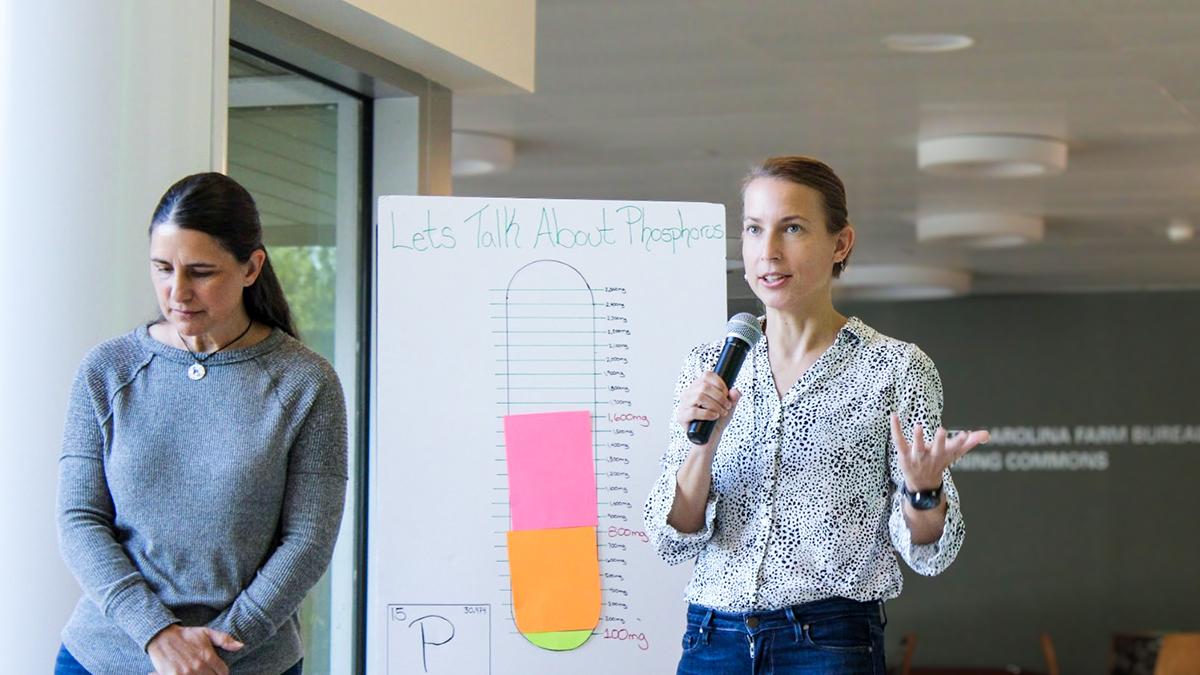
Khara’s priorities for the Center’s future reflect that spirit of connection. She’s interested in expanding collaborations across NC State—particularly with the College of Engineering and interdisciplinary initiatives like the N.C. Plant Sciences Initiative (PSI), STEPS Center, and Bezos Center for Sustainable Protein, where she also holds leadership roles.
“Her national and international presence, and her ability to bridge the natural and social sciences, make her the perfect leader for the future.” — Jennifer Kuzma
“NC State is uniquely positioned to expand its role as a national and international leader in sustainable innovation,” Khara said. “We have incredible expertise across disciplines—it’s just a matter of connecting those strengths in meaningful ways and creating a shared vision.”
That bridging extends far beyond campus. Khara sees opportunities for GES to help shape conversations about biotechnology’s role in sustainable food systems, agriculture, and environmental stewardship. From crops designed to withstand drought and disease to alternative proteins that could complement existing agriculture systems to enhance sustainable protein sources, she sees genetic engineering as central to building more resilient and equitable futures—if guided by inclusive engagement and strong governance.
She continues, “Realizing the full potential of genetic engineering requires more than technological advances alone—it demands interdisciplinary assessment, meaningful stakeholder engagement, and transparent governance.”
Grounded in Values

“When challenges arise, I return to our collective goals as a Center.” — Khara Grieger
For Khara, motivation comes from staying grounded in values and community. “When challenges arise—as they inevitably do—I return to our collective goals as a Center: what we’re striving to achieve together,” she said. “I also reflect on my guiding values of integrity, excellence, and teamwork. Re-centering on those principles always renews my sense of purpose and energy.”
With her collaborative mindset, inclusive leadership, and clear-eyed vision for the future, Khara Grieger is poised to carry the GES Center into its next chapter—building on the foundation laid by Fred Gould and Jennifer Kuzma while charting new paths at the intersection of science, policy, and society.
[major-link url=”https://grants.webtools.ncsu.edu/kdgriege/public-grants” target=”_blank”]Khara Grieger Public Grants[/major-link]
This post was originally published in Genetic Engineering and Society Center.


