Undergraduate Student Gains Hands-on Experience in the Weaving Lab

On NC State’s Centennial Campus, the Zeis Textile Extension’s (ZTE) laboratories include all the equipment necessary to teach about and involve students in every step in the creation of textiles.
Will Swanson, a junior studying textile engineering with a concentration in chemical processing, began working in the Weaving Lab in 2025 and is gaining valuable experience with hands-on textiles work and independent creative projects.
Jumping into textiles
Swanson started his academic journey at NC State in the Engineering First-Year Program, unsure which field he wanted to pursue. When he got a tour of the Wilson College’s facilities from a friend, he was impressed and intrigued.
“Underground, they have all the extension labs, which I was kind of amazed by,” Swanson says. “I thought it was cool how they had students working with all this machinery.”
From there, Swanson decided to dive into textiles. In his current degree program, he has been taking chemical engineering and polymer science classes, each building on the content and technical knowledge of the last.
While on the lookout for research opportunities over the summer, Swanson came across the TECS Research Experience for Undergraduates (REU), which offers research opportunities for students interested in textiles.
Knowing he had an affinity for hands-on work, Swanson signed up to work in the ZTE labs. He was assigned to work in the Weaving Lab as a paid researcher during the summer, and has continued as a student worker through the school year.
Working and weaving
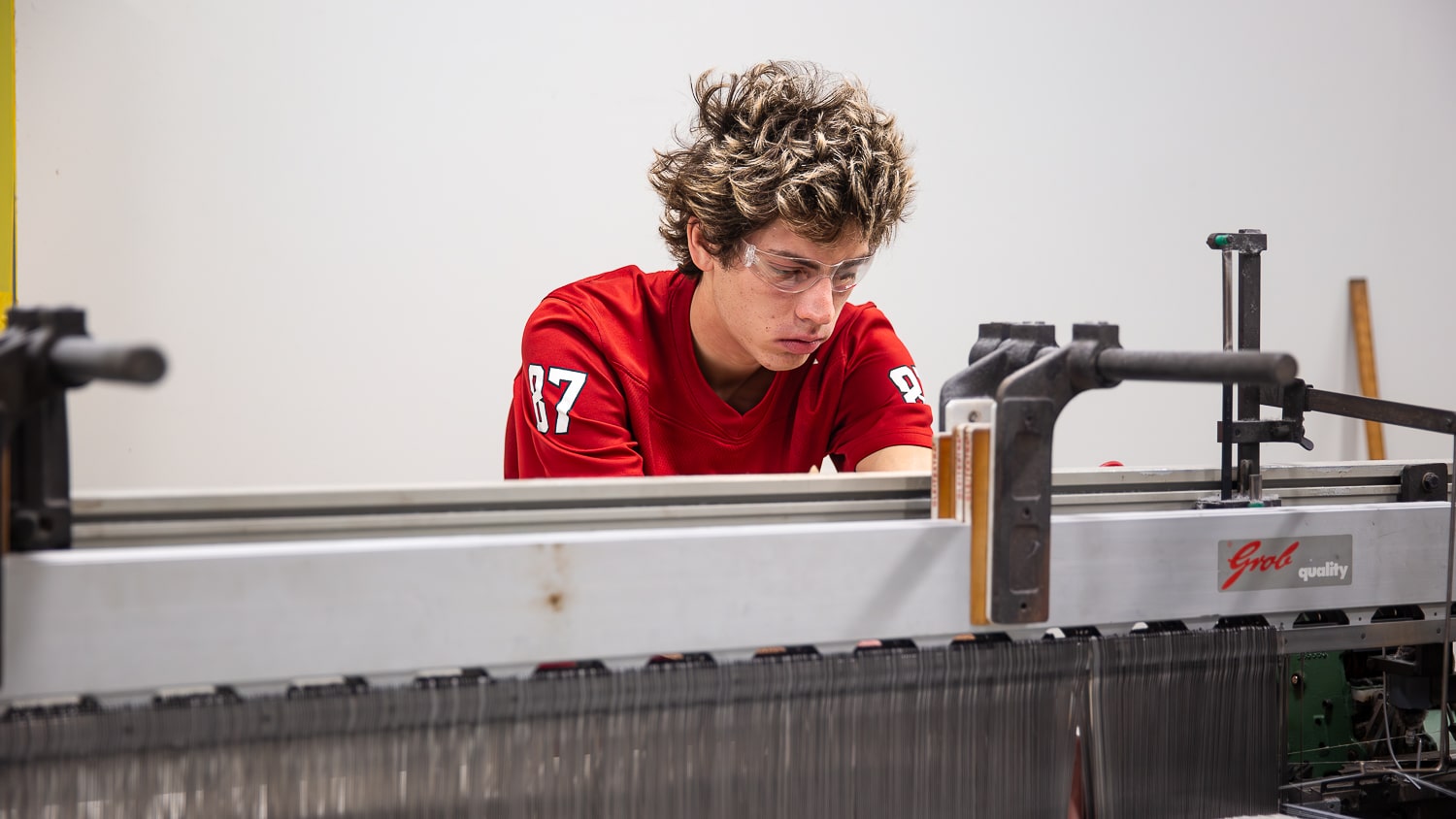
Most of the work in the Weaving Lab involves aiding the operation of the machinery, as most of the industrial processes are not fully automated. Swanson says that he has learned as he works, jumping in and familiarizing himself with new machines whenever it’s necessary.
“I wasn’t working with numbers and data a whole lot,” Swanson says. “I was doing hands-on stuff, which I enjoy more.”
Lauren Navarro, the weaving lab manager, is Swanson’s main supervisor. At first, he learned how each process worked by shadowing her or other students in the lab.
One machine Swanson has familiarized himself with is the bookmark machine, a relatively new addition to the lab, where he has been untangling the weft and wrap yarns. The work can be tedious, he says, but he stays entertained with good conversation and music.
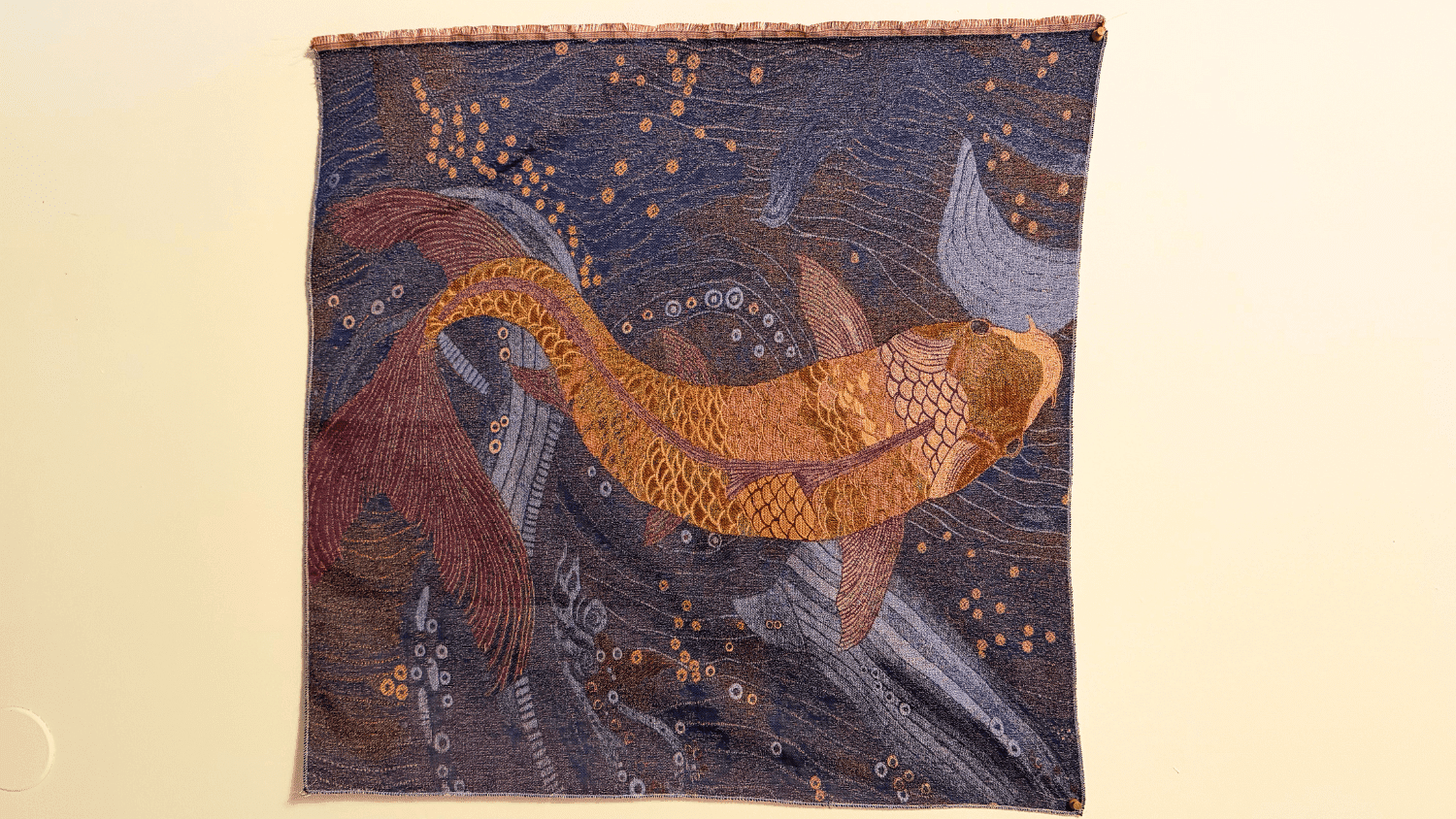
The machine he has gotten to know the most is the Jacquard loom. The machine has impressive automated capabilities, allowing users to digitally edit individual yarns, create their desired images and combine three colors into boundless patterns and illustrations.
“If I want to make a blue, and that’s not one of the colors of the yarn being fed into the machine, you can just combine the magenta and the green next to each other and it’ll trick your eyes into seeing that,” Swanson says. “I wanted to do that and play with the idea of making pixel art on a weaving scale.”
As long as he stays engaged with the work, he has free reign to learn about the machines and work on his own creative projects. Swanson taught himself the programming language of the Jacquard loom so he could test its capabilities. He learned by trial and error, eventually creating a successful cloth with a gradient of swatches woven on the Jacquard loom. After that, he designed and produced a tapestry of a fish, which now hangs on his bedroom wall.
Learning long term
Although he started out ignorant of the world of weaving, calling for help every time there was a hiccup in the process, he says he now feels comfortable troubleshooting and problem-solving on his own.
“My attention span isn’t too long, but I had to learn to just be patient and not get frustrated with stuff because the same problem would happen time after time after time. I had to coach myself like, ‘Okay, I just have to accept the challenge and I can’t get frustrated at it,’” Swanson says.
Seeing the weaving process in such depth, Swanson says, has helped him realize how important it is to be thorough and cautious while working on complex projects.
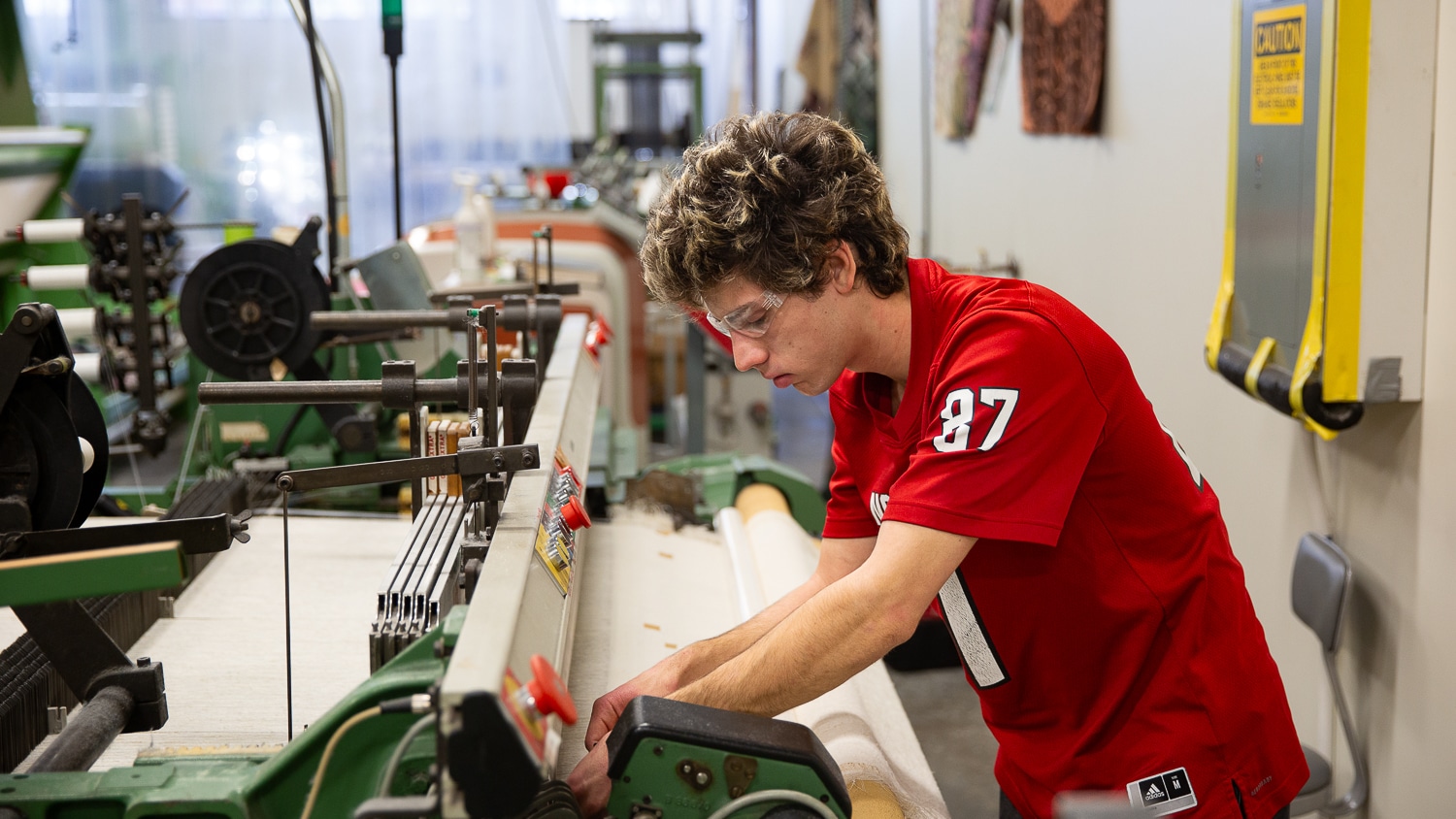
“I actually get to see how things work out from start to finish and why certain mechanisms are doing what they’re doing, and it kind of gave me a glimpse into a whole product cycle,” Swanson says.
He hopes to further pursue research, particularly in medical textiles and athletic wear. Though he is unsure whether he will have a career working in a lab setting, Swanson says the experience is still exciting and is teaching him a lot about his personal work ethic.
“I feel like it’s just good to take on a variety of experiences, even if they’re not necessarily what you are envisioning long term. For something like this, it was an opportunity to dip my toes in. So it has been good to see whatI liked about working in this environment,” Swanson says.
This post was originally published in Wilson College of Textiles News.


