Fundamental Research vs Controlled Research
It is NC State University policy to preserve the right of our faculty and students to freely publish the results of research performed, regardless of the funding source. Exceptions to this policy may be made if US Government research contracts require restrictions on publication or dissemination of research findings for National Security reasons.
Fundamental Research
When NC State researchers conduct research that is free from any publication approval or dissemination control or participation restrictions, the work and the results of that work are outside the scope of the export control regulations. The work is considered “excluded from the regulations.” This exclusion is often referred to as the Fundamental Research Exclusion and the vast amount of research conducted at NC State falls within this exclusion.
Even if fundamental research, the following aspects may still subject to export controls:
- Work done outside the U.S.
- Shipping of tangible items outside the U.S.
- Encryption software/source code
- Export controlled proprietary information
- Controlled input (safeguarding required)
Whether fundamental or controlled, all federally funded research is subject to Research Security requirements laid out in NSPM-33.
Controlled Research
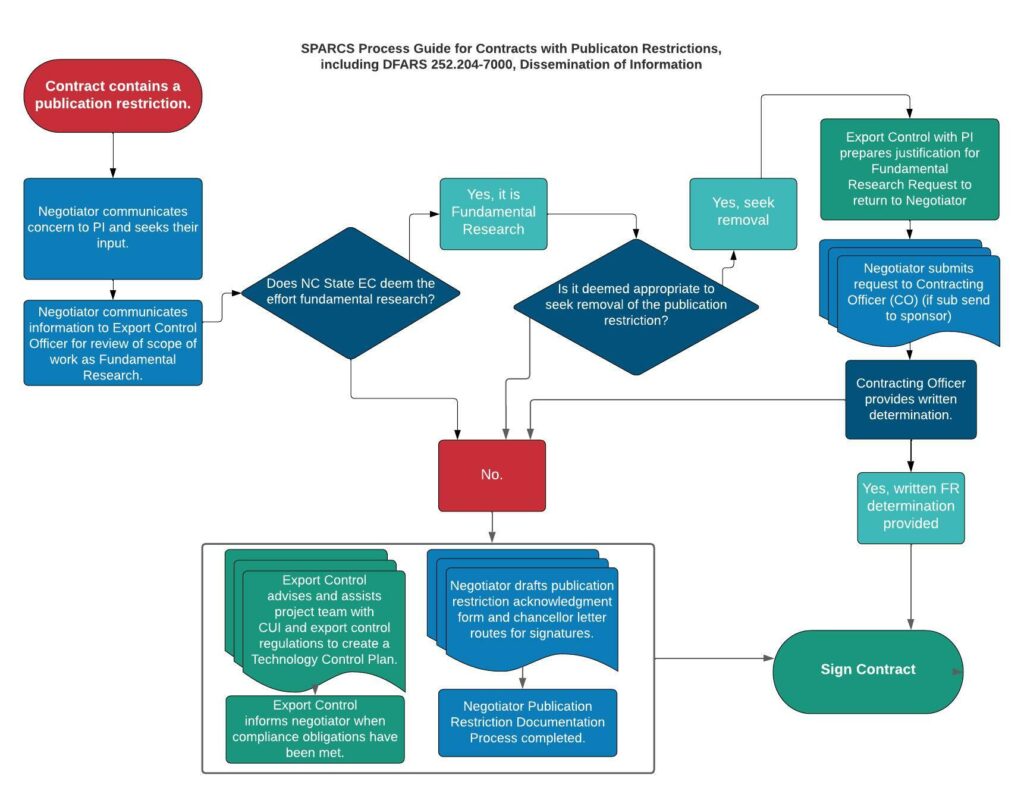
When NC State accepts a contract with a publication or dissemination restriction of research findings or when a sponsor or third party provides proprietary technical information, the information is subject to the export control regulations. US Department of Defense entities impose this restriction by including Defense Federal Acquisition Regulations (DFARS) clause 252.204-7000 Disclosure of Information in research contracts. Where publication restrictions are imposed, the Export Control Office will work with the project team to ensure appropriate controls are in place and documented in a project-specific Technology Control Plan (TCP). Controlled research subject to export controls may have restrictions on foreign participation and access. These will be identified in the related TCP.
What if my project qualifies as fundamental research but has restrictions?
DFARS 252.204-7000 Disclosure of Information is a clause that requires the Sponsor to approve the release of data generated under the effort. As a result of this publication restriction, the resulting technology is subject to export controls and requires additional review for foreign access restrictions and potential enhanced safeguarding requirements. However, included in this clause is the option to request that the Prime sponsor scope and determine that NC State’s contribution is fundamental research, which would essentially lift additional control measures. As often as appropriate, the Export Control Office will work with the PI to prepare a justification that the NC State portion of a project should qualify as fundamental research to limit project restrictions.
In order to work on a controlled project, what must the project participants do?
- Take the appropriate training
- Be screened against U.S. Government Restricted Party Lists and Sanctioned countries.
- Read, understand and acknowledge in writing any applicable Technology Control Plan
Technology Control Plans (TCPs)
When necessary, the Export Control Team will work with the Principal Investigator to develop a Technology Control Plan (TCP) that addresses:
- Authorized personnel
- Dissemination and publication rules (including how to handle student theses that may result from the controlled research)
- Physical security
- Information technology security
TCPs must be signed by:
- Principal Investigator (assumes responsibility to ensure all Project Personnel are following the conditions of the TCP)
- OIT Security & Compliance (unless no controlled information will be stored or transmitted electronically)
- Department Head/Center Director
- Export Control Officer
- All project personnel with access to the controlled research (prior to being granted access)
Plans may need to be amended for any of the following reasons:
- Significant changes to the scope or project plan (including any new effort not originally proposed)
- Personnel additions or deletions
- IT hardware additions or deletions
- IT storage or software changes
- Physical location (office or lab additions or change)
- Significant changes to the physical security
All active TCPs are subject to periodic review and a managed close out process.